
FLOWERS AT SYLVIA KOESTER'S FUNERAL by Earl Shreckengast
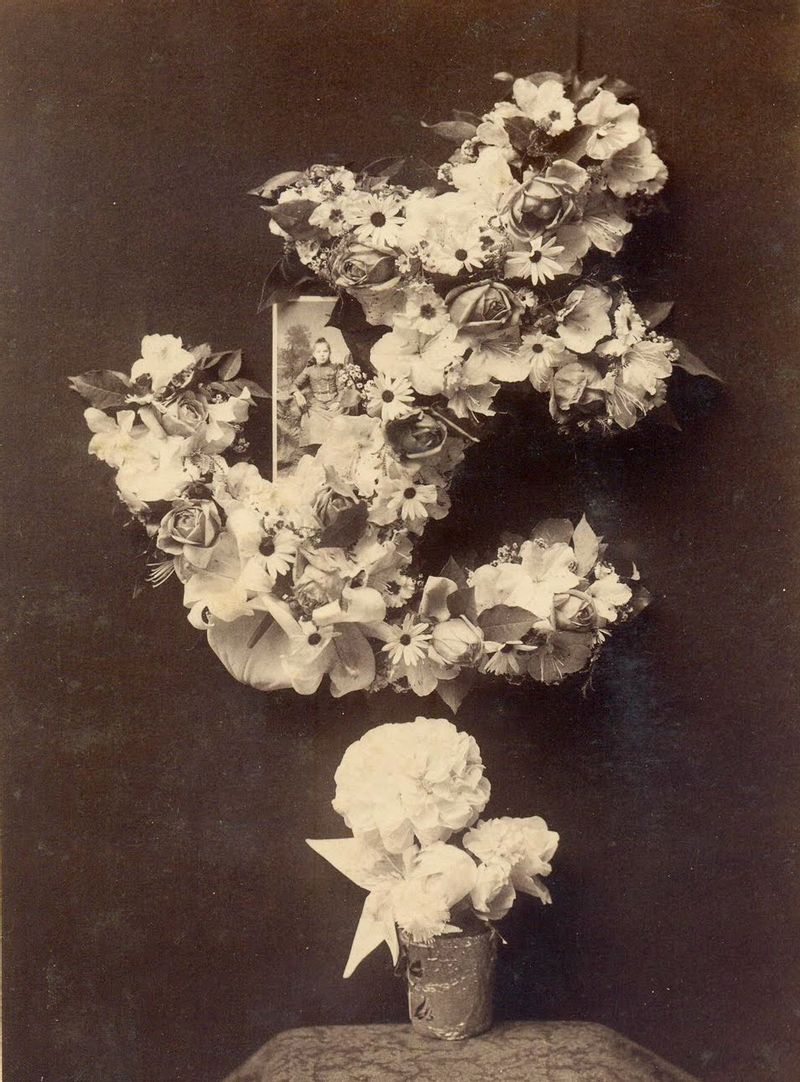
The funeral of Sylvia Broughten Koester was abundant with flowers and rich in Victorian symbolism. Sylvia, the wife of Charles F. Koester, died of consumption in the early morning of April 3, 1883. Her funeral was in the afternoon of the next day at their house, now the Koester House Museum and Garden.
Charles Koester was known for his gardens. He had greenhouses for his own use and ran a floral and plant business out of them. I wondered what kind of flowers would be at his wife’s funeral.
I also thought looking at Sylvia’s funeral might give us insights into funeral practices in the 1880s, particularly the use of flowers and their symbolism. Fortunately, we have detailed obituaries in the Marshall County Democrat and the Marshall County News as well as Charles’ own accounts in his 1883 diary as resources.
Five beautiful arrangements were around Sylvia’s casket. Shipped from St. Joseph the day of Sylvia’s death on the late-night train, the arrangements arrived at the Koester house at 8:00 the next morning in time for the funeral that afternoon. Some of them were sent with sympathy by friends and family.
One arrangement was a representation in flowers of a clock with the hands of the clock set to 7 minutes to one o’clock, the time Sylvia died. Per Charles’ diary, there also was a wreath and what he called a “Crown & C.” Crown & C is florist shorthand for a paired funeral floral tribute: a wreath (the “crown”) plus a coordinated arrangement (the “C”). In this case, the “C” was a pair of anchors to represent hope in the face of loss and the idea of a soul finding safe harbor. These arrangements are typically on stands.
The Marshall County News in its obituary reported that the “cross and crown, anchors, and wreath (were) exquisitely formed from Marcial Neil and Niphetos roses, with Smilax and Maiden Hair Fern.” A favorite of Victorian florists, Niphetos tea roses were the white rose for bouquets and arrangements. The Marcial Neil (Maréchal Niel) tea rose with its large, double blooms added a buttery yellow color and a strong sweet scent. Smilax, a glossy green vine, provided a natural-looking filler and it draped beautifully from casket sprays. Finally, the bright green, feathery Maiden Hair Fern contrasted in color and texture with the other plant materials.
The casket was strewn with magnificent flowers. Inside it were rose buds, White Abutilon (white, bell-shaped flowers), and leaves of Passion Vine.
Sylvia’s head rested on a satin pillow that was filled with rose leaves. The satin pillow is ripe with symbolism in Victorian practice. A satin pillow inside the casket conveys comfort in eternal rest. It suggests peaceful sleep, a gentle transition, and tenderness toward the deceased. Since satin was historically a luxury fabric, using it in burial signified respect and care for the deceased. Choosing a pillow was a final gesture of nurturing, protection, and softness, especially for women and children.
While roses themselves have well‑documented meanings—love, honor, remembrance—the rose leaves that were stuffed into the satin pillow carry a quieter symbolism. They symbolize enduring love. Since rose leaves stay green longer than petals, they represent love that continues beyond death, a memory that does not fade, and the “evergreen” nature of affection.
Rose leaves were used rather than petals because petals bruise quickly while leaves last longer and hold their shape. Thus, rose leaves symbolize steadiness rather than fragility.
Just before the casket was closed, Sylvia’s little children, Tinnie, Jennie, and Charles J.D., each dropped in a bouquet of flowers cut from their mother’s favorite plants.
After the service at the house, the mourners accompanied Sylvia’s coffin in procession to the cemetery. The Marshall County News observed, it “was the largest concourse of friends that formed in funeral procession in this community.” At the cemetery, they “filed by the open grave and cast upon the coffin their sprigs of evergreen and immortelles.”
One of the oldest, most widespread gestures of remembrance, tossing evergreens has several meanings. One is eternal life — because they remain green through winter, they became natural emblems of life that continues beyond death. Another is enduring memory — the mourner’s promise that “I will not forget you.”
French for “everlasting,” immortelles were another way of expressing that memory does not fade. Immortelles are grave decorations made from dried flowers or other durable materials. They were in common use from the mid-1800s to the early 1900s.
Finally, the tomb was filled as the choir sang hymns in German. The mound was then decorated with flowers and the ceremony closed with prayer.
Although Charles Koester had Mr. Newcomb, a local photographer, photograph the five arrangements at Sylvia’s funeral, we don’t have those photos in the archives. What is pictured above is an example of an anchored-shaped floral arrangement from the late 1800s. Two arrangements similar to this were on tripods around Sylvia’s casket.
Originally posted by Koester House Museum & Gardens via LocableKoester House Museum & Gardens
919 Broadway Street
Marysville, KS 66508
785-562-2417
www.koesterhousemuseum.com
Alert
We're open but with new hours/limited operations!
The museum is closed from November - March for regular tours. Special tours may be arranged. Watch our calendars & posts to announce special events to be held at the museum during our closed winter months.
Tue
10:00am–4:00pm
Wed
10:00am–4:00pm
Thu
10:00am–4:00pm
Fri
10:00am–4:00pm
Sat
10:00am–4:00pm
Sun
1:00pm–4:00pm