
April 14, 2026 Blog Victorian Funeral Practices at Koester Funeral
VICTORIAN FUNERAL PRACTICES AT SYLVIA KOESTER’S FUNERAL
When Sylvia Koester died in 1883, American funerals were largely home centered and were steeped in Victorian mourning etiquette. Many practices that we are familiar with today—embalming, funeral homes, floral tributes—were just beginning to take hold, while older customs like all-night vigils and parlor viewings were customary.
Sylvia Koester’s funeral had many examples of Victorian mourning and funeral practices. We are privileged to have an inside look at them because of the detailed writings of her husband, Charles Koester, in his diary. Among the practices were the following:
Preparing the body: Before the rise of professional embalmers, families washed, dressed, and arranged the deceased themselves. In Sylvia’s case, per her wishes, she was washed and dressed by Alice Broughten, her brother’s wife; Jane Schmidt, her husband’s sister; Mary Morehouse, her aunt from Illinois; and Jennie Schmidt, her niece. Sylvia died just before 1:00 a.m. and by 4:30 a.m. they completed the ritual of dressing “Mama” in her “Heavenly Robe” as Charles Koester described it.
Laying out the body: The deceased was almost always laid out in the front parlor, sometimes called the “death room.” After Sylvia’s body was washed and dressed, it was moved to her favorite room, the east sitting room, and laid in its bay window as she designated the Saturday before.
Watching over the body: Families and close friends sat with the body continuously, day and night, until burial. This practice was partly spiritual (warding off evil) and partly emotional (showing respect). Mrs. Lofink “kindly trims with Crepe “Mama’s Rocking Chair” in which she was carried from Hotel and to the Train at St. Joseph.”
Charles Koester noted in his diary that various friends and family “are sitting up.” Among them were Mrs. Clark; Mrs. Edwards, Sylvia’s doctor’s wife; Mrs. Lofink, Sylvia’s friend, milliner, and the wife of the town’s grocer; Mrs. Grimm, wife of Charles’ carpenter; Mr. Goelitz; and brother-in-law Frank Schmidt. They were “sitting up” the evening of April 3, the day Sylvia died, and the early morning of April 4.
Although the body was typically observed for three days, often called a wake, it was not the case with Sylvia. Her funeral and burial were the day after she died.
Holding the funeral at home: The home in Victorian times was open to neighbors, acquaintances, and the wider community; funerals were public events, not private family gatherings.
At noon in a private moment, “the Loving Hands” placed Syliva’s body in her casket as she directed. The honor went to Sylvia’s brother John, her sister-in-law Alice, her aunt Mary Morehouse, her niece Jennie Schmidt, and her husband Charles.
Later mourners arrived at the house. Charles Koester recounted the events. “At 1 o’clock some lady friends arrive . . . at 2 o’clock very many people come to pass the last respects to dear Wife. The Lodge of A. O. U. Workmen (a fraternal society) attend in body . . .”
The funeral service itself was held at the house. Ministers from the M.E. Church and the German Evangelical Church conducted the service, and the Presbyterian Church choir offered hymns. Then those who wished to passed by the open casket to take a last look at the remains.
Processing to the burial site: Processions were typically horse drawn, with the coffin carried to a churchyard or cemetery. Charles Koester’s diary doesn’t specifically say that the coffin was pulled by a horse, but it is likely given the distance from the house to the new cemetery. The procession itself was the largest that Marshall County had seen according to the accounts in the newspapers. “From the residence the remains were followed to the cemetery by the largest concourse of friends that ever formed in funeral procession in this community.”
Following household rituals: Victorians followed rituals in their homes that symbolized death and mourning. Mirrors were covered to prevent the soul from becoming trapped, black crepe was hung on the door to signal mourning to the community, clocks were stopped at the moment of death, and/or portraits were wrapped in black.
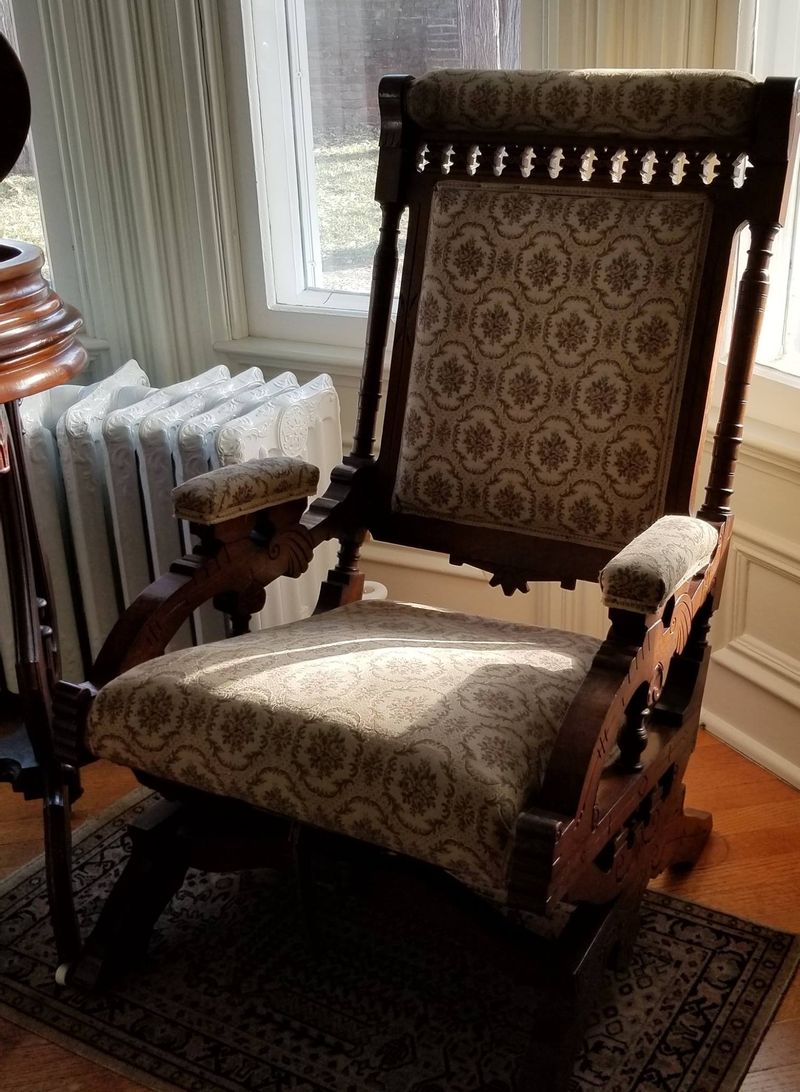
In Sylvia’s case, the practice of “household mourning” took the form of a chair that she used being draped in black crepe. Charles wrote in his diary that Mrs. Lofink “kindly trims with Crepe ‘Mama’s Rocking Chair’. . .”
Pictured above is Sylvia’s rocking chair that is in the bay window of the east sitting room of the Koester House Museum. This is the room in which her body was laid out after it was washed and dressed, and the rocking chair may well have been the one Charles wrote about being wrapped in black crepe.
Originally posted by Koester House Museum & Gardens via Locable
Koester House Museum & Gardens
919 Broadway Street
Marysville, KS 66508
785-562-2417
www.koesterhousemuseum.com
Alert
We're open but with new hours/limited operations!
The museum is closed from November - March for regular tours. Special tours may be arranged. Watch our calendars & posts to announce special events to be held at the museum during our closed winter months.