
If This House Could Talk -- Blog #21
Before me, Charles had an immigrant’s journey. Having lost their home, he and his family left Germany when he was 10 years old and sailed to New York. From New York they took the train to Cincinnati where his grandparents on his mother’s side (Muth) and his uncle Charles lived. All along the way, they were seeking opportunities to build a new life in a new land.
The Koesters stayed with the Muth’s for a brief time and ended up living in Cincinnati the first two years. Charles began working in the orchards when he was 11 years old to help earn money for the family. He later recalled that he picked cherries for 25 cents a day and picked potatoes for a peck a day. Men working on the farm received 50 cents a day.
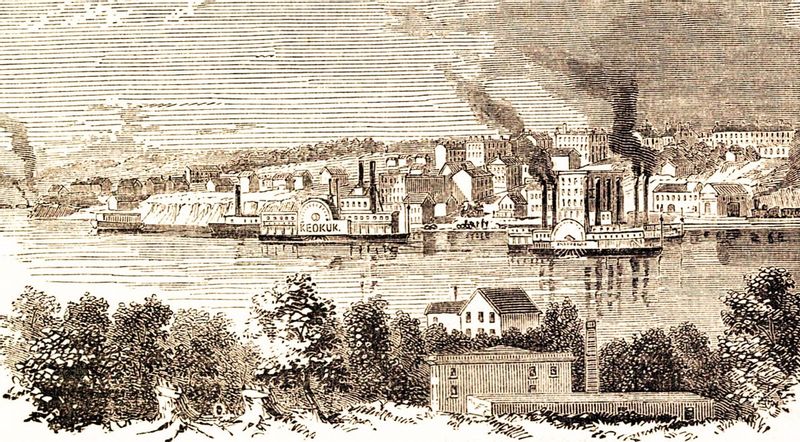
As the family saved funds, they moved further west in search of land they could afford and a place to settle down and live. Their next stops were Fort Madison, Iowa and Keokuk, Iowa. The two towns, 16 miles apart along the Mississippi River, were boom towns that had many German and Irish settlers.
Charles remembered their time in Keokuk when he passed through it in 1900 on a train trip. “It is here as strangers in language and purse, we landed to earn a living. Here we began very lowly indeed.” Their first purchase was a little house in Kilbourne’s Addition at the corner of 18th and Johnson Street for $225 in cash. “It was with others the smallest and far out on Johnson Street. No one can begin with less than did we.”
Charles worked as a waiter at Ivine House. He started at $1.50 a week and after two years earned $2.00 a week.
It was in Keokuk that Charles’ sister Jane met Frank Schmidt and married him on May 1, 1856. Charles became a U.S. citizen on February 16, 1857, when living in Keokuk.
During this time, the Koesters made a couple of side trips to search for affordable land. Charles and his mother took a steamboat up the Mississippi River to Davenport, Iowa. It was small, only a few streets along the river, and it was surrounded by hills covered in hazel brush. They walked out to see some land on the hillside, but they could not buy it.
Another scouting trip took them across the Mississippi River from Montrose, Iowa to Nauvoo, Illinois. They heard that the Mormons had abandoned their settlement there to go to Salt Lake. They thought they might find inexpensive houses, and they did. However, a colony of French speakers had taken possession of it, and in Charles’ words, “We did not long to live there.”
After Keokuk, they went to Wyandotte City, Kansas (now Kansas City, Kansas) in 1858. They were there for five months before moving to St. Joseph, Missouri.
In April 1859, Charles opened Branch Restaurant Ice Cream Saloon & Confectionery in Atchison, Kansas. He sold it in September to return to St. Joe to look after brother-in- law Frank Schmidt’s business while he was in Europe.
While in Atchison, Charles bought his first real estate. He paid $400 for 11 acres. It took all he had in the world to buy the property.
On August 3, 1860, Charles, his parents, his sister Jane and brother-in-law Frank Schmidt, and the Schmidt’s young child, Francis, left St. Joseph for the arduous trip to Marysville. They arrived five days later on August 7 at 9:00 p.m.
The above drawing is of Keokuk, Iowa in the 1850s. Keokuk was a thriving river town at the confluence of the Mississippi and Des Moines Rivers.
Originally posted by Koester House Museum & Gardens via LocableKoester House Museum & Gardens
919 Broadway Street
Marysville, KS 66508
785-562-2417
www.koesterhousemuseum.com
Alert
We're open but with new hours/limited operations!
The museum is closed from November - March for regular tours. Special tours may be arranged. Watch our calendars & posts to announce special events to be held at the museum during our closed winter months.
Tue
10:00am–4:00pm
Wed
10:00am–4:00pm
Thu
10:00am–4:00pm
Fri
10:00am–4:00pm
Sat
10:00am–4:00pm
Sun
1:00pm–4:00pm