
If This House Could Talk -- Blog post #30 -- City of Lights
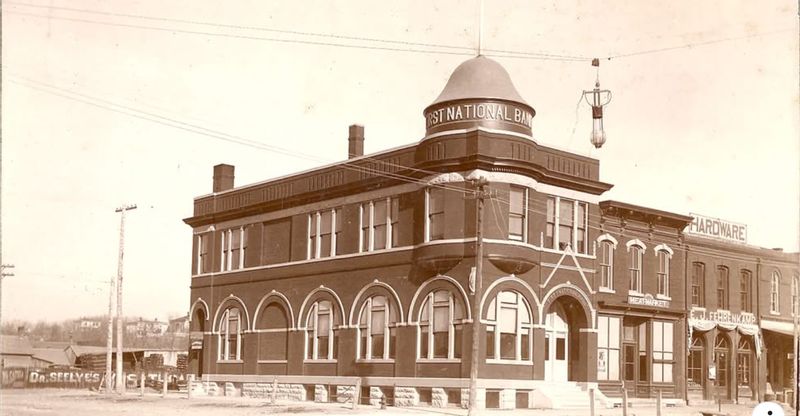
Within four months of the passage of Bill 86 in May 1888 by the Marysville City Council, Charles had electric lights installed here. That ordinance gave Benjamin Swan and George Parish who were doing business under the firm name of Marysville Electric Company a 10-year right to operate electric works in Marysville.
Charles was not the only one to embrace this new technology. The City of Marysville itself had arc light lamps on its streets. Standard Arc Electric Lamps of 2000 candlepower were located at key places throughout the city. The brightness of these lights was comparable to car headlights on high beam.
Charles saw one night how bright Marysville was when he was away from town for business. It was dark and cloudy. The vivid, constant flashing of lightning gave a panorama to the skies and the prairie. From five miles away, the electric lights of the town appeared in a brilliant greenish hue, a glow which was different from the normal looks of the electric lights in town.
The Electric Light Company had its ups and downs. In 1890, it was reorganized. Five thousand dollars was invested. Charles bought 20 shares for $1,000. He was elected treasurer. S. A. Fulton of the First National Bank was elected President.
The generating capacity was more than tripled to a 650-light dynamo. The plant was moved to Hutchinson’s Mill so that water could be used instead of steam to generate electricity. The electric lights were brighter and steadier, and it was cheaper.
Three years later it was time to increase the power plant’s capacity and modernize. The owners of the Electric Light Company decided to return to the former plant location near the train depot. They bought a lot next to the former plant in December 1893 and committed to put an addition on the old building.
They also met with Mr. Lee of Chicago and bought two one-hundred horsepower boilers. They negotiated well. They got two completely outfitted boilers, listed for $2,400, for $1,350 in cash. They made an additional $800 outlay to give Marysville a first-class electric plant. According to Charles, “Although not a cent received as dividends so far for three years on an investment of $1,500, the town cannot afford to lose the plant.” By June 1894, the plant was completed and in operation, doubling the number of lamps.
In February and March of 1897, there was no electricity for several weeks. The two smokestacks at the electric plant needed to be replaced with new ones. Charles commented, “This has left our town in darkness, and this is so unpleasantly felt when leaving the office at late hours. All is darkness. When we are so used to have all light, so comfortable, the darkness, to us, has more of the feeling for evil doers and their dangers than were we not so used to the brilliant lights.”
Eventually things looked up businesswise for the Electric Light Company. Looking at the 1895 results, Charles reported that the electric company made hardly enough to pay expenses. By 1898, the shareholders had $800 in the treasury, and so they bought the land that the plant sat on for $500. Charles owned the parcel. They did not declare a dividend, however. Charles was elected President of the Electric Light Company in 1899 and re-elected in 1900. In 1901, the company had $580 in its treasury and declared a dividend.
Marysville, Kansas transitioned to a city-owned electric light company in 1903.
Marysville had electric lights before some other Marshall County towns. Blue Rapids got them in the summer of 1902. Axtell got electrical power in 1912 when it purchased it from Seneca.
By 1896, Marysville had 16 electric arc lights for its streets. One of those arc lights is prominent in the above photo of the First National Bank. Mr. S. A. Fulton of that bank was elected President of the Electric Light Company when it was reorganized by investors in 1890. Charles Koester was its treasurer. (Photo courtesy of the Marshall County Historical Society)
Originally posted by Koester House Museum & Gardens via Locable
Koester House Museum & Gardens
919 Broadway Street
Marysville, KS 66508
785-562-2417
www.koesterhousemuseum.com
Alert
We're open but with new hours/limited operations!
The museum is closed from November - March for regular tours. Special tours may be arranged. Watch our calendars & posts to announce special events to be held at the museum during our closed winter months.