If This House Could Talk - Blog Post #29 -
I remember that there was quite a bit of excitement when the electric lights were turned on Saturday night, August 25, 1888. Over 3,000 people gathered for the event!
The Marysville Advocate of August 30, 1888, captured the moment: “Last Saturday night was a time long to be remembered on account of the turning on of the electric current and lighting our city by electricity. At an early hour the streets were packed with people from far and near, all eager to see the effect. At 8 o’clock p.m. the current was turned on, but to the surprise of all, it lasted but a few minutes. Something about the engine did not work right, which caused a delay of about an hour, when the current was again turned on to the satisfaction of all. The band discoursed sweet music and speeches were made.”
There was a lot of activity in the five months leading up to the grand activation. In April, two entrepreneurs, Benjamin Swan and George Parrish, proposed to the Marysville City Council that they be granted the right to operate an electric company. Bill 86 was passed by the Council at its May meeting. That ordinance granted Swan’s and Parish’s Marysville Electric Company the right to operate an electric works, to erect poles along the streets, and to provide electric arc lamps to the City for its use.
The electricity company embarked on an aggressive timetable to install all the equipment for the electric lights. The Brush Electric Company of Cleveland, Ohio was engaged to do the work. The Brush system in Marysville had a capacity of 20 arc and 200 incandescent lights. There were two dynamos, one for the arc lights and one for the incandescent lights. The power was furnished by a 40 horsepower Ideal engine and a boiler furnished by English Morse & Co of Kansas City.
Initially, there were 12 arc lights and 125 incandescent lights contracted for. The City of Marysville ordered eight arc lights.
Per the Marysville Advocate, based on the orders, “The best lighted store room in the city when the electric light is completed will be Kohn & Selz’. The best lighted residence will be that of Hon. Chas. F. Koester. Kohn & Selz will have an arc light and four incandescents in their storeroom, and Mr. Koester will have 21 sixteen candle power incandescent lights in his residence and one 65 candle power light on his lawn.”
The Methodist church took one of the lights. It was the only church in Marysville to order one and it was the second church west of the Mississippi to put in electric lights.
Even though Charles was among the first to have electric lights in his home, he did not put electric light fixtures in his building in the Koester Block until 1897, nine years later. He installed them because the gas machine which had given good service from the time the block was built in 1880 was out of order.
When the circus and its 200 employees came to town in 1898, the lights were kept on all night for the security of the town. Normally, the electricity was turned off at midnight.
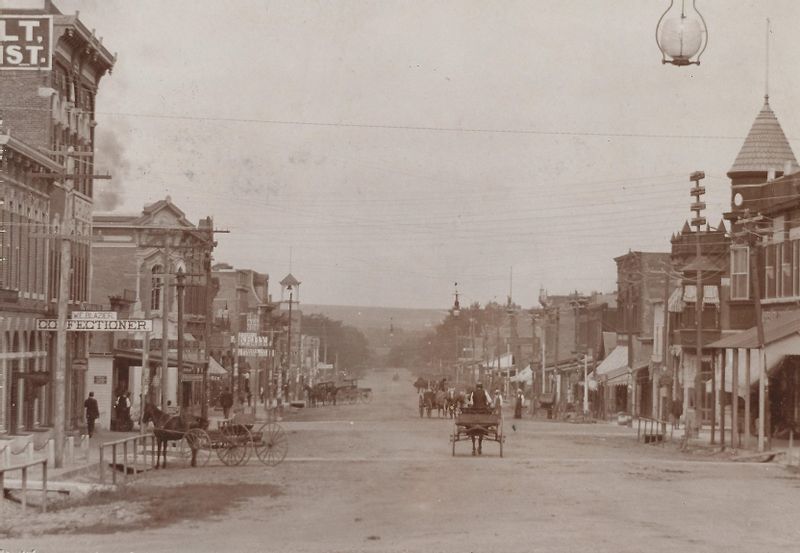
The above photograph of Broadway from 1899 was taken in the Koester Block. The globe of one of the eight electric arc lights that were installed in 1888 is on the top right of the photo. Harder to see farther west along Broadway are two more arc lights suspended over the street. The poles for the electric wires are up and down both sides of Broadway.
Originally posted by Koester House Museum & Gardens via Locable
Koester House Museum & Gardens
919 Broadway Street
Marysville, KS 66508
785-562-2417
www.koesterhousemuseum.com
Alert
We're open but with new hours/limited operations!
The museum is closed from November - March for regular tours. Special tours may be arranged. Watch our calendars & posts to announce special events to be held at the museum during our closed winter months.