
If This House Could Talk -- Blog Post #28
I am proud that I had electric lights before the White House and that Charles wasn’t afraid to touch the light switches like President Benjamin Harrison and his wife, Caroline, were. Electricity was so new—and intimidating—that the Harrisons reportedly refused to touch the light switches for fear of electric shock. I had electric lights in 1888 and the White House in 1891.
Charles first saw electric lights in St. Louis during a trip there in 1881. In May 1888, the City Council of Marysville approved an ordinance to install arc lights for all-night use. In June, the contractor who is to install the lights solicits Charles. He quotes $1.25 per month for each light. Charles thinks the cost is too high and passes at that time. However, in July 1888, Charles contracted with an electrician to install 16 lights throughout the house plus one lamp for the greenhouse and one for the summer kitchen. The installation work was finished on August 10, 1888. In September, brass chandeliers were installed in the house at a cost of $80. I was electrified in four months.
Installing the lights was quite a job. It took several days. Mr. Redmond, the electrician, and his crew started with the knob-and-tube wires in the cellars. They also put a lamp in the greenhouse and one in the summer kitchen on the first day. Mr. Grimm, the carpenter, also helped by taking up the boards in the floors where needed. By 5:00 p.m. on the third day, the project was done. Charles presented Mr. Rosamond with a cigar and smoking case, and a box of 100 cigars for a job well done.
I agree with Charles. Since we have electric lights in our house, all feel much more comfortable. It seems so new, so bright, so cheerful. I recall Charles saying, “We ourselves feel more cheerful and elevated by our surroundings. The brightness has a fine effect upon everything.”
Charles noticed the difference when the lights weren’t working. When the electricity was off because the company was moving to a different location, Charles said, “The corners so dark, streets dismal, and the garden foliage does not reflect in their rich shades.”
It was a few years later that Charles, within several miles of home, observed, “…how grandly show the electric lights. The arc lights eclipse the stars, and this beautiful sight has been a source of admiration on returning home from extended country drives many times.”
Charles wasn’t finished with installing lights in 1888. A year later, he added more electric lights bringing the total to 22. It cost Charles $125 per year for the electric service ($4,230 in today’s dollars). He paid it in monthly installments of $10.40 ($353 in 2025 dollars). In 1891, he added yet another electric light to the garden. The wires were buried underground.
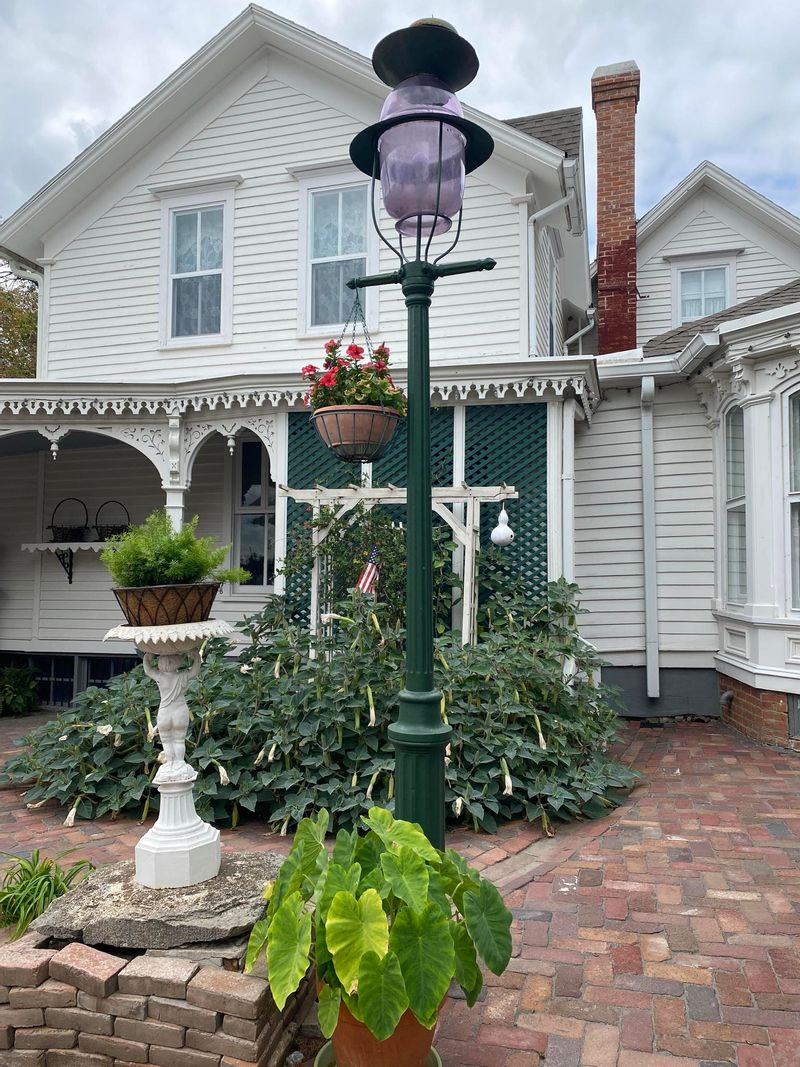
Pictured above is an original lamp post. In 1898, Charles reset it near the well and changed the globe. Charles thought the new globe had a more handsome lamp than the square one that had been there. He had Mr. Hammett, the stone mason, relay the brick walk since the electric wires had been put underground. The lamp post and globe are in the courtyard to the south of me.
Originally posted by Koester House Museum & Gardens via Locable
Koester House Museum & Gardens
919 Broadway Street
Marysville, KS 66508
785-562-2417
www.koesterhousemuseum.com
Alert
We're open but with new hours/limited operations!
The museum is closed from November - March for regular tours. Special tours may be arranged. Watch our calendars & posts to announce special events to be held at the museum during our closed winter months.